
The Problem with Unowned Accounts
- Richard Serna
- Jan 8
- 2 min read
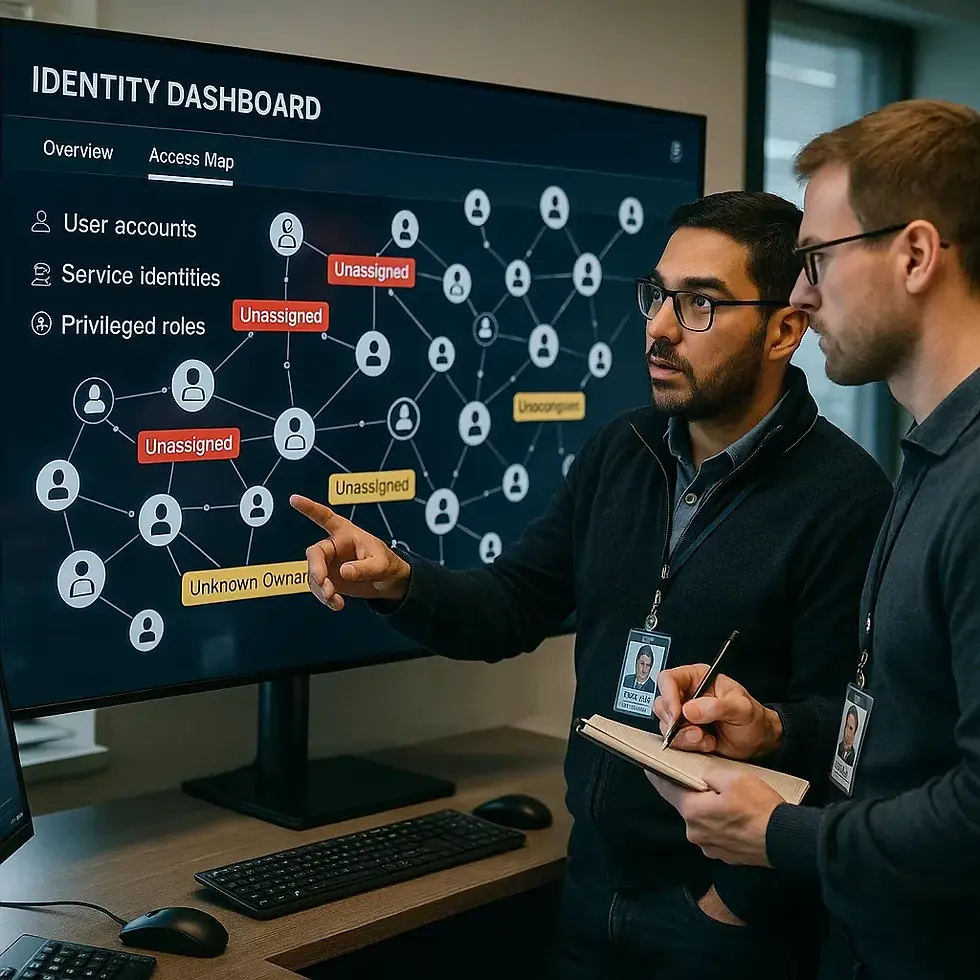
As organizations grow, so does the number of user accounts, service identities, and privileged roles across systems. In fast-moving environments, it becomes easy to lose track of who owns what.
Unowned accounts are one of the most persistent blind spots in identity and access management. They seem harmless at first. But when no one is clearly responsible, those accounts quickly become security liabilities.
Why Ownership Clarity Matters
Every account in a system should have a purpose, a business justification, and an accountable owner. Without that, these accounts:
Remain active long after they are needed
Escape regular access reviews
Avoid proper credential rotation
Become prime targets during lateral movement attacks
Ownership is what drives responsibility. When it is missing, no one is managing risk, and no one is notified when something goes wrong.
The Impact on Privileged Access Management
Privileged accounts carry elevated risk, but they are often the most poorly tracked. In traditional models, PAM focuses on controlling access. But without knowing who owns the account, control means very little.
You cannot rotate a password if no one knows who uses it. You cannot revoke access if you are not sure who should have it. And in a breach, response teams waste precious time trying to determine who is responsible for the affected identities.
Ownership Is Not an IT Task. It Is a Governance Function.
Clear ownership is a business issue, not just a technical one. Each identity, whether tied to a person or a system, should have a designated owner who understands:
The role and function of the account
The risks tied to its access
Their responsibility in reviewing and maintaining its usage
This is especially important in hybrid environments, where cloud roles, API keys, and service principals are created across multiple teams with minimal oversight.
How to Establish and Enforce Ownership
Improving ownership accountability requires a few key practices:
Assign ownership at creationMake owner assignment a mandatory part of every identity creation process. This applies to human users, machine identities, and service accounts.
Tag and track ownership in your identity systemsUse IAM platforms that support ownership fields and integrate with your provisioning workflows. Make it easy to generate reports on unowned or outdated identities.
Automate notifications and reviewsRoute access reviews, password rotations, and alerts directly to the responsible owner. This reduces time spent tracking down the right person.
Review ownership as part of role changesWhen someone leaves a department or changes roles, their owned accounts should be reassigned or decommissioned. Automate these transitions wherever possible.
Enforce accountabilityOwners should be accountable for the lifecycle of their identities. That includes deprovisioning unused accounts, responding to alerts, and participating in audits.
A Small Shift That Strengthens the Whole System
You do not need a complete platform overhaul to fix ownership issues. You need a cultural and procedural shift that treats identity like inventory. If it exists, someone is responsible for it.
The best PAM strategies do not just control access. They build trust through clarity. Ownership is the foundation of that trust.
Security improves when every account has a name next to it. No more guessing. No more gaps. Just a clean chain of accountability.


Comments